Victoria West
Along for the RideVictoria West is Auden’s mother, a prominent scholar whose command of academic life stands in striking contrast to the emotional reserve Auden associates with her. Her career brings her recognition, books, and an endowed chair; at home, her marriage to Robert deteriorates in conflicts Auden learns to hear from her bedroom. The portrait is filtered through Auden’s judgments, but its central tension is clear: Victoria’s authority and achievement do not make her family life feel secure or openly shared.
Identity and Background
Victoria is an academic scholar of women’s roles in Renaissance literature, known for her intelligence, sharp wit, and national reputation. When Auden compares her with Heidi, she describes her mother as a very different kind of woman: a scholar with a formidable public profile, rather than someone whose strengths lie in personal grooming, fashion, or effusive correspondence. That contrast reflects Auden’s own exasperation with Heidi as well as the distance between the two women.
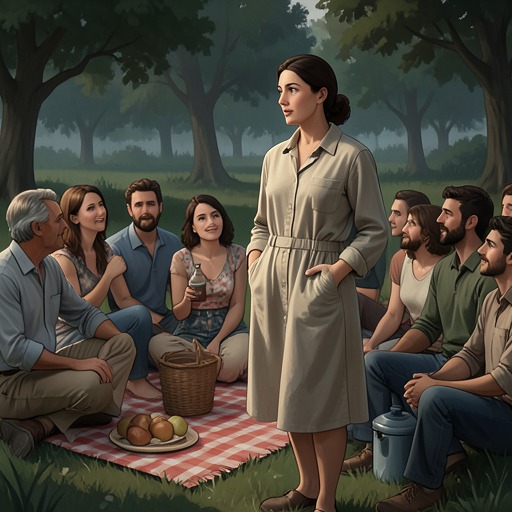
Victoria’s professional standing is matched by a striking appearance. Auden describes her as tall and curvy, with very long, loose black hair, which she sees as the one uncontrolled element in her mother’s presentation. At one of Victoria’s graduate-student dinners, male students gather around her as she discusses Christopher Marlowe and women’s culture. Her composed gesture of pushing back her hair accompanies a low, raspy voice; she declines a student’s suggestion that she develop her argument into an article, saying indirectly that she has little time to write and is already working on a book.
Academic Career and Marriage
Victoria and Robert came to the U after graduate school, when Robert received an assistant professorship. At that point, he had found a publisher for his first novel, The Narwhal Horn, while Victoria was pregnant with Hollis and trying to finish her dissertation. By the time Auden was born, Robert had become a commercially and critically successful novelist and was leading the creative-writing program. Victoria, meanwhile, described herself as lost among diapers and self-doubt.
When Auden entered kindergarten, Victoria returned to academia. She secured a visiting lectureship and a publisher for her dissertation, became one of the department’s most popular professors, moved into a full-time position, and published further books. She later earned an endowed chair, while Robert lost his publisher after the success of his first novel. Robert joked that Victoria had become the family’s breadwinner, and claimed to be proud of her; the difference between her growing institutional prestige and his professional setback preceded a worsening of their relationship. By the time Auden describes her, Victoria has four books, numerous articles, and an endowed chair.
The strain at home reaches Auden through recurring, delayed arguments. Fights between Victoria and Robert often begin over dinner with a small remark, sharp words, or a banged pot lid, then resume around ten or eleven at night, after they believe Auden has fallen asleep. Auden deliberately leaves her bedroom door open, keeps her light on, and makes conspicuous trips to the bathroom to postpone the later arguments. The tactic works only temporarily; eventually she becomes accustomed to staying awake and hears every word.
Relationship with Auden
Victoria’s separation from Robert is announced across the kitchen table, with Robert leaning against the counter and fidgeting with his hands. Victoria delivers the news in the flat, businesslike manner Auden recognizes from her academic critiques, presenting the separation as the best course for the family. Auden is not surprised, but she is struck by how little she feels. The moment makes her feel small and newly, belatedly like a child—a response that contrasts with the controlled formality of the announcement.
Their relationship includes contact across distance, but not effortless intimacy. After Auden calls her mother, Victoria answers by name and says she had thought Auden might call. The exchange establishes recognition and expectation without resolving the emotional reserve between them. Auden’s recollection of Victoria’s dismissive response to Maggie, and of her judgmental attention to the bikini bottoms and Booty Berry, places Auden herself within the same broad category of people Victoria does not approve of. On the beach, Auden recognizes the breadth of that rejection and, for the first time, feels glad to have company in it.
Characterization and Narrative Role
Auden presents Victoria as a study in contradiction. She is an expert on women in literature, yet Auden believes that she does not much like women in practice. Victoria’s graduate gatherings are a concrete expression of that tension: male students attend and admire her, while female students seldom come and rarely return. Auden attributes this pattern partly to jealousy of Victoria’s intelligence, scholarship, and looks, but the account remains her interpretation rather than an impartial explanation of the students’ choices.
Victoria’s academic authority also sharpens the contrast between public competence and private communication. At work, she is an acclaimed professor whose arguments command a room; in the family, her announcement of separation is delivered with the impersonal precision of a critique. The novel’s account of her is shaped by Auden’s watchfulness—by overheard arguments, remembered gestures, and judgments about whom her mother welcomes or excludes. Victoria’s significance lies partly in that gap: she is both an accomplished woman with a life of her own and, to Auden, a mother whose achievement and decisiveness have not translated into uncomplicated closeness.